


How Long Does Artificial Disc Replacement Last?
Artificial disc replacement is a motion-preserving alternative to spinal fusion, but many patients have a more practical question: how long will the artificial disc actually last? If you are considering surgery for chronic neck or back pain, durability matters. You want relief now, but you also want a solution that continues to support your spine years from today.
Modern artificial discs are built for long-term performance. These implants use durable medical-grade materials and are designed to preserve movement at the treated spinal level rather than permanently locking the bones together. By maintaining more natural motion, artificial disc replacement may reduce stress on nearby discs and help protect the spine’s mechanics over time.
Still, no implant exists in isolation. The longevity of artificial disc replacement depends on careful patient selection, precise implant placement, bone quality, spinal alignment, and a recovery plan that allows the disc to function as intended. The best outcomes come from matching the procedure to the patient, not simply choosing the most advanced technology.
Dr. Joel Beckett approaches artificial disc replacement with that long-term perspective. The goal is not just to replace a damaged disc. It is to preserve motion, restore function, and help patients make a durable investment in their spinal health.
Artificial Discs are Engineered for Longevity
Artificial disc replacement is built around a simple but demanding idea: the implant must preserve motion while tolerating years of repeated movement, load, and stress. Modern artificial discs are made from durable medical-grade materials, often including metal alloys such as cobalt-chromium and specialized polymers such as high-density polyethylene. These materials are selected because they can resist wear, maintain stability, and function in the mechanically demanding environment of the spine. Moreover, artificial discs are shaped to mimic the natural motion of the spine at that level to allow bending, rotation, and slight translation rather than locking the bones together. When an implant moves in a controlled, physiologic way, it distributes forces more evenly across the device and the surrounding bone, which supports long-term performance.
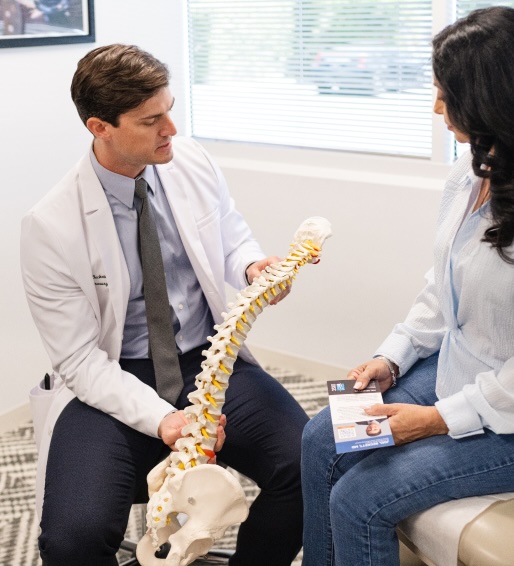
In the cervical spine, this motion preservation can help protect the smaller joints and discs above and below the operated level that would otherwise be forced to compensate after a fusion. In the lumbar spine, where forces are higher, modern disc designs focus on stability as well as motion, using keels, fins, or porous coatings to anchor firmly into the vertebral bodies. The result is an implant that can bear everyday loads while still allowing patients to turn, bend, and live actively.
ADR Is Designed as a Long-Term Motion-Preserving Solution
Artificial disc replacement is not intended as a temporary spacer or short-term pain procedure. In the right patient, it is designed to replace a damaged disc, preserve motion at the treated level, and provide durable relief from symptoms caused by degenerative disc disease. The goal is not simply to remove the painful disc. The goal is to restore more normal spinal mechanics so the neck or back can continue to move in a controlled, functional way.
This is one of the key differences between artificial disc replacement and spinal fusion. Fusion can be very effective when instability, deformity, or severe degeneration makes motion unsafe. However, fusion permanently locks two or more vertebrae together. That loss of motion can place additional stress on the discs above and below the fused segment, which may contribute to adjacent segment degeneration over time.
Artificial disc replacement takes a different approach. By preserving motion at the treated level, ADR may reduce abnormal stress on neighboring discs and help maintain a more natural pattern of spinal movement. For properly selected patients, that motion-preserving design can make ADR a strong long-term option, especially when the goal is to relieve pain while protecting function for years ahead.
Clinical Data and the Lifespan of Artificial Discs
When patients ask how long an artificial disc will last, the most honest answer comes from long-term clinical trials rather than theoretical projections. Over the past two decades, multiple cervical and lumbar disc replacement devices have been followed for seven to more than twenty years, and the results consistently show durable pain relief, preserved motion, and low revision rates in appropriately selected patients.
The Longevity of Cervical Artificial Disc Replacement
For cervical artificial disc replacement, one of the strongest data sets comes from the FDA investigational device trials of the Mobi-C disc. In a multicenter study of 599 patients with one or two levels of disease, overall success rates at seven years were significantly higher with disc replacement than with fusion, particularly for two-level disease. Two-level Mobi-C cases achieved a 60.8% overall success rate compared with 34.2% for ACDF and required fewer reoperations at both the treated and adjacent levels.
Those benefits persisted over time. Ten-year follow-up of the same Mobi-C cohort showed that improvements in neck disability, neck pain, arm pain, and neurologic function were maintained or even slightly improved between years seven and ten. Importantly, there were no new adjacent-level surgeries between the seven- and ten-year marks, and only two additional reoperations across the entire study group during that interval.
ProDisc-C has also demonstrated durable performance at the decade mark. In a single-center study with average follow-up of approximately ten years, patients maintained good clinical and radiographic outcomes, with mean segmental range of motion of about 6–7 degrees at the operated level. Implant-related reoperations were rare, and only a small subset of patients required additional surgery for adjacent segment disease over that ten-year period.
When researchers pool cervical disc replacement studies together, the picture remains consistent. A 2022 systematic review and meta-analysis including dozens of trials with at least five years of follow-up found reoperation rates after cervical disc arthroplasty around 5–7%, often lower than rates reported after fusion. A major health technology assessment that compared cervical arthroplasty with ACDF concluded that disc replacement not only provides at least equivalent symptom relief, but also reduces index-level reoperation, helps preserve motion, and appears to lower the long-term risk of clinically significant adjacent segment disease.
The Longevity of Lumbar Artificial Disc Replacement
The longest follow-up for lumbar total disc replacement now extends beyond twenty years. A landmark analysis of 1,187 patients treated with ProDisc-L reported outcomes from roughly seven to twenty-one years after surgery. In that cohort, the index-level revision rate was only 0.67%, and the need for adjacent-level surgery was 1.85%, rates that compare very favorably with what is typically reported after lumbar fusion.
Randomized trials of newer lumbar devices support similar conclusions at mid- to long-term follow-up. In a seven-year IDE trial comparing ActivL and ProDisc-L, both groups maintained significant improvements in pain and disability with overall reoperation rates under 5%, and opioid use dropped to zero in both device groups by the seven-year mark. A separate series evaluating the M6-L disc showed maintained motion at the treated level, low rates of adjacent segment degeneration, and only a single index-level revision in patients followed up to ten years.
Taken together, these cervical and lumbar studies indicate that modern artificial discs are performing as they were designed to perform; they provide lasting pain relief, preserve motion, and keep revision and adjacent-level surgery rates low over the long term.
Factors That Influence the Longevity of Your ADR
Artificial disc replacement is designed for long-term durability, but the implant itself is only one part of the result. The best outcomes depend on how well the procedure fits the patient’s anatomy, condition, and spinal mechanics. Several factors can influence how long an artificial disc continues to function well.
- Surgical Precision: Accurate placement matters. An artificial disc must sit in the right position and orientation to move properly and distribute force evenly. Poor positioning can increase stress on the implant, the bones, or the nearby spinal levels. This is one reason experience with motion-preserving spine surgery is so important.
- Bone Quality and Integration: The artificial disc must anchor securely to the vertebral bones above and below the treated disc space. Healthy bone helps support long-term implant stability and reduces the risk of shifting, subsidence, or loosening. This does not mean the vertebrae fuse together. Instead, the implant is designed to remain stable while the treated level continues to move.
- Patient Activity Levels: Most patients are able to return to an active lifestyle after recovery, but repetitive high-impact forces may place more demand on the implant and surrounding spine. Running, heavy lifting, collision sports, and intense athletics should be discussed with the surgeon as part of a long-term activity plan.
- Biomechanical Alignment: ADR works best when the rest of the spine is balanced. If there is significant deformity, instability, arthritis, or abnormal alignment, the artificial disc may face excess stress. A careful evaluation helps determine whether motion preservation makes sense or whether another treatment would provide a better result.
ADR vs. Spinal Fusion: A Longevity Comparison
Artificial disc replacement and spinal fusion differ most in how they affect spinal movement. Fusion can be the right operation when a spinal level is unstable, severely collapsed, deformed, or unsafe to preserve. By joining two vertebrae together, fusion can reduce painful motion and restore stability. The tradeoff is that the fused level no longer moves, which may shift more stress to the discs and joints above and below it.
Over time, that added stress can contribute to a condition called “adjacent segment degeneration.” Patients who develop adjacent segment degeneration have pain, nerve symptoms, or mechanical problems at neighboring levels and may eventually need additional treatment including additional spine surgeries.
Instead of locking the treated level, ADR replaces the damaged disc while preserving controlled motion. By maintaining more natural motion, the implant may reduce excess stress on nearby discs and joints. For the right candidate, that motion-preserving design may reduce stress on nearby levels and help maintain more natural spinal mechanics over time. For properly selected patients, ADR can provide a durable option that supports pain relief, motion, and long-term function.
Dr. Beckett’s Approach to Lasting Results
Long-term results after artificial disc replacement depend on more than the implant itself. Dr. Beckett’s approach focuses on choosing the right treatment, matching ADR to the right patient, and guiding recovery in a way that protects motion and function over time.
H3: The Tiered Treatment Philosophy
Dr. Beckett follows a tiered treatment philosophy. Surgery is not the first step for most patients with degenerative disc disease. When appropriate, treatment begins with conservative care, physical therapy, medication strategies, targeted injections, and other non-surgical spine treatments designed to reduce pain and improve function. These options can help many patients avoid surgery altogether. For patients who do need an operation, this careful progression helps ensure that surgery is recommended for the right reason, at the right time, and with the least invasive yet effective approach.
Confirming ADR Is the Right Fit
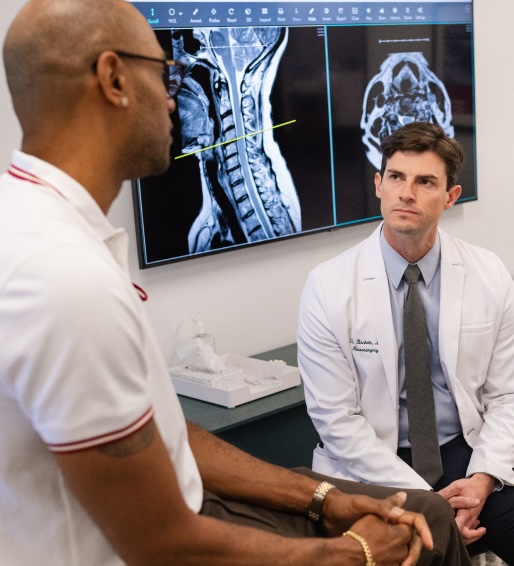
Long-term success with artificial disc replacement starts before surgery. The most important step is determining whether ADR is truly the right operation for the patient. Dr. Beckett evaluates the diagnosis, imaging, spinal alignment, bone quality, neurologic symptoms, and activity goals before recommending a motion-preserving procedure. A well-designed implant can only perform as intended when it is matched to the right anatomy and the right clinical problem.
Supporting the Implant (and the Patient!) After Surgery
Recovery also matters. After ADR, Dr. Beckett guides patients through a structured post-operative plan that protects the implant while strength, mobility, and confidence return. Activity advances in stages; patients focus on posture, physical conditioning, and safely returning to work, exercise, and daily life. The goal is not just a successful surgery. The goal is a durable result that supports long-term motion, comfort, and spinal health.
Invest in the Future of Your Spinal Health
Artificial disc replacement is not just a procedure to relieve pain today. For the right patient, it is a long-term strategy designed to preserve motion, support function, and reduce stress on the surrounding spine. That makes careful evaluation essential. The best results come from choosing the right operation for the right diagnosis, anatomy, and goals.
If chronic neck or back pain is limiting your life and you want to understand whether artificial disc replacement is appropriate, schedule a consultation with Dr. Joel Beckett. A personalized evaluation can help clarify the cause of your symptoms, review your imaging, and determine whether ADR or another treatment offers the best path forward for your long-term spinal health.
FAQs: ADR Longevity and Maintenance
Can an artificial disc wear out over time?
Yes, but modern artificial discs are designed for long-term durability. Significant wear or implant failure appears uncommon when the right patient receives a well-positioned implant. Longevity depends on implant design, bone quality, surgical placement, spinal alignment, and activity demands.
Will I ever need a revision surgery after ADR?
Most patients who do well after ADR do not need revision surgery. However, revision can be necessary if the implant shifts, loosens, causes persistent symptoms, or if another spinal level becomes painful over time. Careful patient selection and precise placement help reduce that risk.
How do I know if my artificial disc is still working correctly?
A well-functioning artificial disc should support pain relief, stable motion, and improved daily function. New or worsening arm or leg pain, numbness, weakness, balance problems, or bladder or bowel changes should prompt evaluation. Follow-up visits and imaging can help confirm implant stability.
Are there specific activities I should avoid making the disc last longer?
Most patients can return to an active lifestyle after recovery, but high-impact sports, collision activities, and heavy repetitive lifting may place more stress on the spine. The goal is not to avoid movement. It is to return gradually, build strength, and follow activity guidance based on your surgery and recovery. Dr. Beckett provides individualized guidance based on the procedure, implant level, recovery progress, and the patient’s long-term activity goals.